
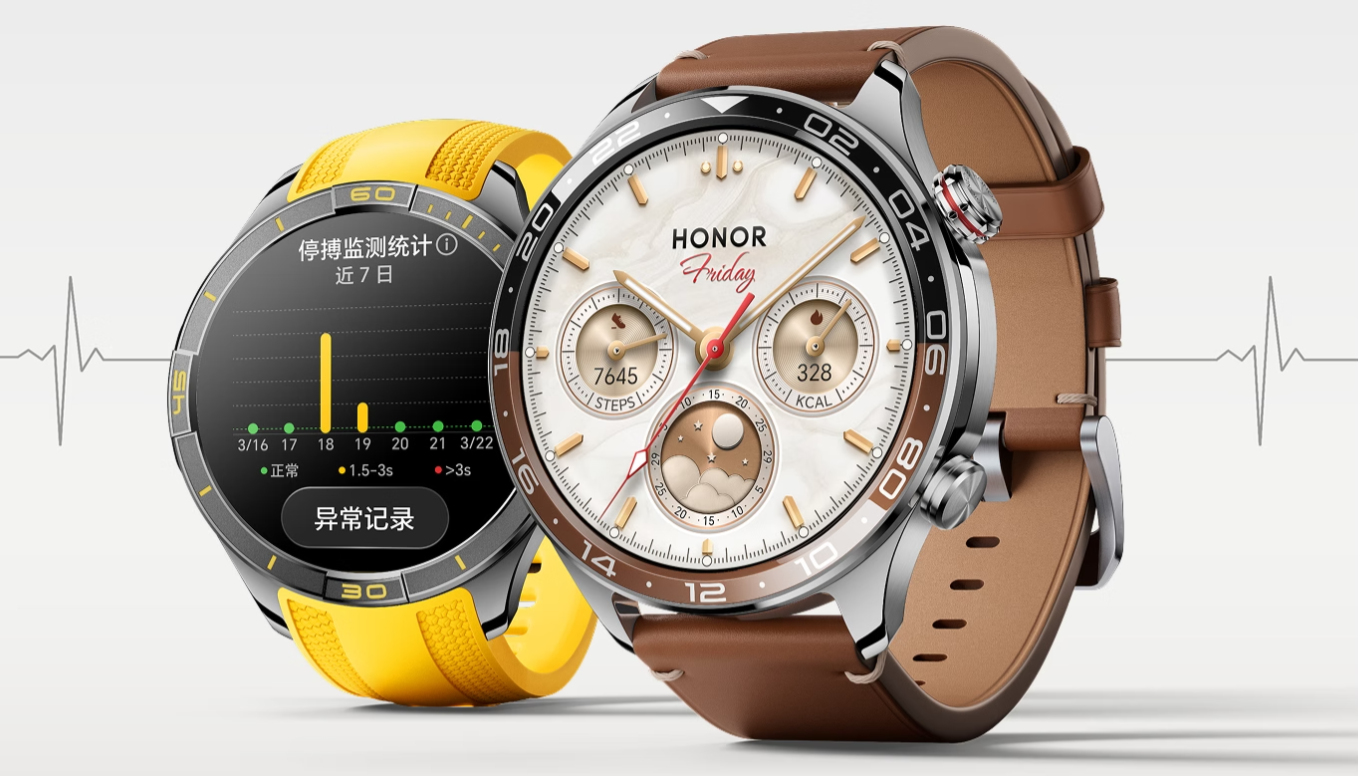
Recently, Honor officially launched its smartwatch, Watch6 Pro. According to Honor, it features “the world’s first dual-layer OLED display for wearables.” Alongside this 1.5-inch AMOLED panel comes an impressive set of specs: a partial peak brightness of up to 5,500 nits and full-screen brightness reaching 4,500 nits. Both metrics set new global records for brightness in wearable OLED screens.
Behind this product lies support from display supplier Visionox’s ViP (Visual Pixelization) plus Tandem stacked-series OLED display technology — marking the first mass production shipment of this combined solution for wearable devices. The Tandem stacked structure further unlocks potential in brightness, power consumption and service life, while ViP visual pixelization technology delivers a pixel fabrication approach distinct from the conventional FMM route.
This compact screen represents an important direction in the evolution of OLED display technology. The combination of ViP and Tandem not only elevates the user experience of wearable products, but also offers new industrialization ideas for expanding Tandem into more end-device categories.
From “Good Performance” to “Mass Adoption”: Tandem Still Needs to Overcome Manufacturing Barriers
Tandem is not a brand-new technology. In recent years, it has been deployed in premium products such as automotive displays, tablets, smartphones and laptops.
The core principle of Tandem OLED is stacking two or more light-emitting units inside a single OLED device, connected in series via a charge generation layer. Put simply, two sets of light-emitting units work in tandem to share the lighting workload. By distributing the luminous load, Tandem can boost brightness output while reducing stress on single-layer devices, delivering higher brightness, lower power draw and longer lifespan.
In recent years, Tandem OLED has gradually been adopted in high-end applications including automotive panels, tablets and laptops. Companies such as LG Display and Samsung Display have pushed commercialization of related products. After Apple adopted Tandem OLED for the iPad Pro, market attention toward this technology rose further.
With the continuous development of AI terminals, premium displays and smart cockpits, market demand for high brightness, low power consumption and long service life keeps growing. Tandem is evolving from a “bonus feature” found only in a handful of flagship products into a “fundamental requirement” that high-performance OLED products must address.
Nevertheless, to move from “premium and capable” to “widely adopted”, Tandem faces a major manufacturing hurdle.
In the small-and-medium-size segment, RGB Direct Emission remains the mainstream solution to meet requirements for high PPI and fine display. Its traditional process relies on FMM (Fine Metal Mask) to complete evaporation and alignment for red, green and blue pixels separately. When OLED evolves from a single layer to Tandem, the number of light-emitting layers doubles, bringing extra evaporation and alignment steps. Mask deformation and cumulative alignment errors in each step demand much tighter control, directly raising process difficulty and yield ramp-up costs.
Beyond the coupled complexity of manufacturing processes, coordination between devices and the complete system presents another big challenge. Tandem OLED typically requires a higher driving voltage than single-layer OLED. Accordingly, backplane pixel circuits, driver ICs and power supply schemes all need adaptive evaluation based on device characteristics. For product development, this requires joint tuning among panel makers, chip vendors and end brands, translating to higher verification costs and longer validation cycles.
Device performance has been proven feasible. Whether manufacturing methods can support large-scale production has become a critical puzzle to solve for Tandem’s next phase of development. Visionox’s answer is its self-developed ViP technology.
Gestant Display Technology Co.,Ltd. could provide a series of LCD,OLED and PCBA products, such as AMOLED Screen, PMOLED Screen, Round Display Screen, Flexible Display Screen, TFT LCD, Mono-LCD and Bar Display Screen. Customize PCBA/LCD/OLED/FPC/Backlight/Coverlens/TP solutions.
Gestant Display Technology Co.,LTD was founded in 2012 in Shenzhen China. Even, the founder of the company, has more than 15 years of rich experience in LCD display industry. He has been engaging in the basic research of LCD display technology in Japan since his graduate school and has been working in the flat panel display industry after graduation.
Proficient in the manufacturing process and technology development of LCD / OLED / polarizer, Even was also one of the members of China liquid crystal Association who has a senior industry background and supply chain resources. In the past three years, he assisted his shareholders in building factories, purchasing equipment,establishing production lines, and successfully obtaining ISO9001 and ISO14001 system certificates.
He has established good business relations with major panel manufacturers in China (BOE /Tianma / IVO /EDO / Visionox), and the glass supply is stable and sufficient.
Gestant Display's products are widely used in Smart wear,Smart home,Outdoor photography,IP phones, Medical care, Industrial control equipment, Automotive and Vehicle displays, Instrumentation, and other Information terminal applications which could offer long-term after-sale services(such as 2 years quality warranty, long-term supply) .